
What to Teach?
As teachers, we have the capability to impart knowledge in various subjects. Some individuals are so skilled that they possess knowledge in multiple domains and can teach several topics within each domain. With such a wealth of knowledge, it's natural to wonder where to start and what to teach. Based on my experience, I'd like to provide some guidelines to help you choose the right topics effectively.
How Many Subjects to Teach?
When it comes to teaching, there are two extremes. On one end, we have teachers who attempt to teach every topic in every subject within their domain of expertise. On the other hand, there are teachers who focus solely on one specific topic within a subject.
Let's consider the perspective of a student who subscribes to both types of teachers on YouTube. The student subscribes to both teachers for their videos on Topic 'A'. When both teachers upload new videos, the student receives notifications. The student watches the first teacher's video and is disappointed because it does not cover Topic 'A,' which is the reason the student subscribed. Then, the student watches the second teacher's video, which indeed focuses on Topic 'A.' The student is delighted and shares this video with peers.
Now, fast forward six months, and think about which teacher will have more views, subscribers, and opportunities for success. Clearly, the second teacher is likely to be more successful.
Here, you can apply this principle to various companies as well. For example, Flipkart initially focused solely on selling books and achieved success before expanding into other product categories.
I hope you've received the message that the more focused your channel is, the more opportunities for success you'll have. Try to focus on one subject and avoid moving on to another until you have covered the first subject comprehensively. When you do move to a new subject, choose one related to the domain of your initial subject. Let your audience's comments guide your future video topics.
What to Teach in a Subject?
Teaching a subject involves much more than just conveying theory and practical knowledge that aids students in achieving academic goals. Apart from this, educators can create videos that showcase the practical applications of a subject in everyday life. These videos can also help students prepare for competitions related to that subject.
Where to Begin?
When it comes to teaching within a specific subject, one might wonder where to start, considering that numerous videos on the same subject can be created. There are two possible approaches to this. First, you can begin by creating videos that cover the entire subject comprehensively, starting from the basics and continuing until the advanced topics. Second, you can first explore the existing videos on the subject to identify which topics have not been adequately covered. You can then start creating videos on these overlooked topics, based on the comments and feedback received from your audience.
I recommend choosing the second approach because almost every teacher starts from the basics, resulting in an abundance of introductory videos for every subject. However, videos that explain the challenging aspects of a subject are relatively scarce.
Based on the Success of Production
Teaching within a single subject can cover a wide range of topics. You can teach facts, concepts, processes, procedures, and principles related to that subject.
Facts: These are pieces of information that students need to memorize, such as the value of pi (π) being 3.14 or the fact that the sun rises in the east.
Concepts: Concepts involve specific terminology related to a subject, like "triangle" in mathematics or "saturated solution" in science.
Processes: Processes explain how something works. For example, you can teach how a pump functions, how the heart operates, or how to send an email from a mobile phone.
Procedures: Procedures detail how to perform a specific task, like disassembling a petrol engine or creating a website.
Principles: Principles are fundamental ideas or theories, such as the law of supply and demand in economics or Pythagoras' theorem in mathematics.
In terms of production, it's easier to teach concepts and procedures, and students often prefer procedural content. Therefore, I recommend preparing a list of all procedures related to your subject, teaching them first, and then planning your videos accordingly.
Success Based on Keywords
Did you know that you can quickly achieve success on YouTube by creating videos on topics that are heavily searched for?
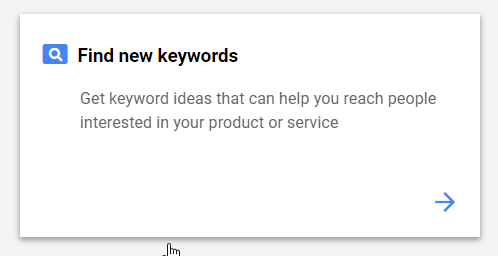
While it's not necessary to have expertise in every highly searched topic, you can explore which topics are frequently searched by using Google's Keyword Planner. Inside the tool, choose "Find new keywords."
This helps you identify which keywords related to your subject have high search volumes. For instance, when I searched for "arduino," I found that it gets searched 100K to 1M times per month.
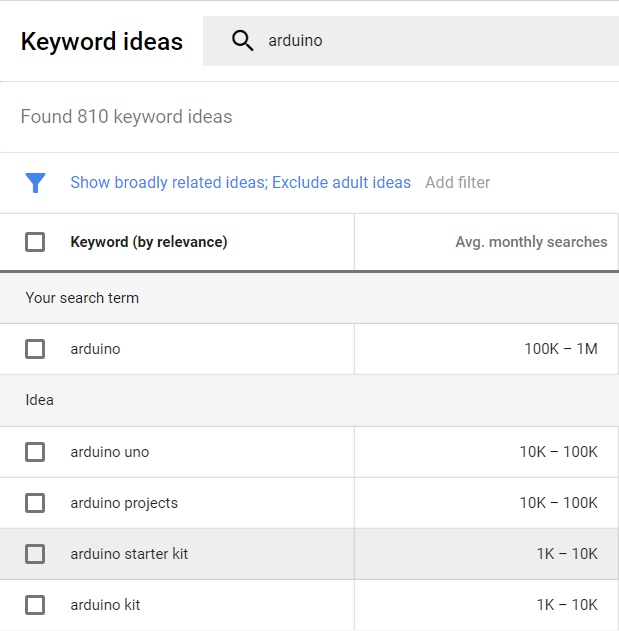
Conversely, when I searched for "arduino starter kit," the search volume was much lower, ranging from 1K to 10K searches per month. Based on this data, I can be certain that I should focus more on creating videos related to "arduino," "arduino uno," and "arduino projects" to increase the chances of my videos being viewed more frequently.
Answers are generated by AI from this book’s content and may be imperfect — the chapters themselves are the source of truth. This is the same technology behind our AI Teaching Assistant service.