What Moodle Hosting Really Costs in 2026 (And the Cost Nobody Counts)
How much does Moodle hosting really cost? A founder-honest breakdown — MoodleCloud, DIY VPS, and managed hosting in USD and INR — plus the biggest cost nobody counts: your time.

Moodle is free. It's open-source software, and it costs nothing to download. So most people arrive at the same expectation: if the software is free, hosting it should be cheap — or nearly free.
It isn't. Moodle is a serious, capable application, and running it well is not the same as running a small website. You can't just drop it on the cheapest shared hosting and expect it to work — it won't. Moodle needs a proper server, or at least a good VPS, behind it. (I've written a full guide on exactly what Moodle needs to run well — read that and it becomes obvious why cheap, shared hosting can't do the job.)
So what does it actually cost? Let's go through it honestly — the sticker prices, and the costs almost everyone forgets to add up.
The three ways to host Moodle — and what each really costs
There are broadly three ways to run Moodle. Here's what each one costs, and who it's for.
1. MoodleCloud (the official hosted option)
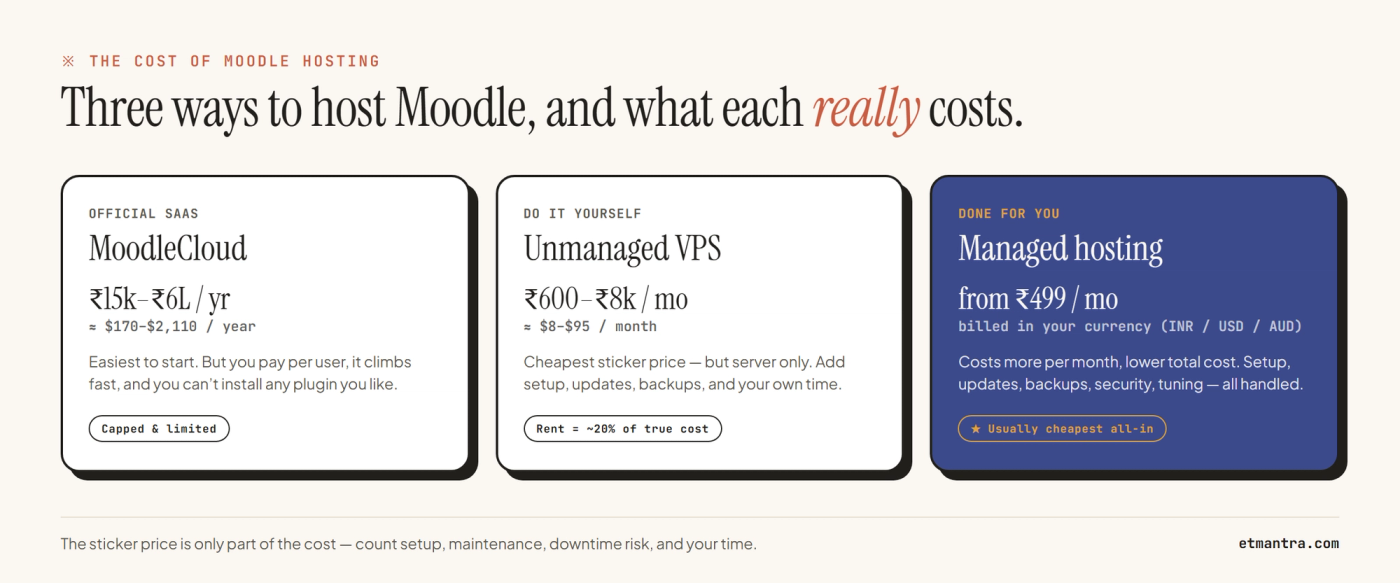
MoodleCloud is Moodle's own hosted service. It's the easiest to start with, but you pay per user, and it climbs fast.
The entry plan is around ₹15,000 a year (roughly $170) for about 50 users. That sounds fine — until your numbers grow. We're writing courses for institutions with 2,000+ students. At that scale, MoodleCloud would run you into the region of ₹6 lakh a year (around $1,200–$2,100). For most institutes, that's simply not worth it.
And there's a second catch beyond price: MoodleCloud limits you. You can't install any Moodle plugin you like — you're restricted to what Moodle bundles for you. If you want the full flexibility of Moodle (any plugin, any theme, real customisation), MoodleCloud will hold you back.
2. A VPS you manage yourself
The next option is to rent a VPS (virtual private server) and install Moodle on it yourself. On price alone, this looks like the cheapest route.
A VPS starts at roughly ₹600–₹800 per month (about $8–$10) at the low end, rising to ₹7,000–₹8,000 a month (around $85–$95) for the higher tiers you'd need as you grow. (For which specs suit which student count, again, see the requirements guide.)
That per-month number is what makes people say: "I'll just take a VPS, do the setup myself, and save money." Hold that thought — because that's exactly where the hidden cost lives, and we'll come back to it.
3. Managed Moodle hosting
The third option is managed hosting — a company installs Moodle for you, manages it, updates it, backs it up, and takes responsibility for the whole thing. It costs more per month than a raw VPS, but as you'll see, the total cost is usually lower.
This is what we do at ETmantra. Our Managed Moodle Hosting starts at ₹499 per month and comfortably handles about 100 students, with larger plans above that. (We also bill international clients in their own currency — so the price you see isn't locked to rupees.) With managed hosting, the server, the requirements, the installation, the upgrades, and everything that can go wrong become our responsibility. What's left for you? The thing that actually matters — managing your students, building good courses, and focusing on teaching.
The cost nobody counts: your own time
Here's the part almost every "Moodle cost" article skips, and it's the most important one.
When people choose a VPS, they think the cost is just the rent — "₹800 a month, done." It isn't. A VPS is a bare machine. It doesn't even come with the software installed. You have to:
- install the operating system,
- install the web server,
- install and configure the right PHP version,
- install the database and everything else Moodle requires,
- install Moodle itself,
- then handle the monthly maintenance forever — updates, backups, and fixing things when the server or Moodle breaks.
That's hours and hours of work. Realistically, you need a technical person on the server for a couple of days to set it up, and then ongoing time every month after that. Plugins and libraries go out of date, security patches appear, the server gets attacked — and every one of those is your problem to solve. Hours disappear.
Now put a number on it. In India, a server administrator's time runs around ₹2,000 an hour. Once you count the setup and the monthly maintenance at that rate, the picture flips completely: the VPS rent is only about 20% of the real cost. The other 80% is your time — or the salary of whoever you hire to do it.
And that's if things go well. If for any reason you don't manage it properly — no in-house expertise, no time — your site goes down, stays down, and the real cost becomes invisible but far bigger: your students stop trusting the platform. That's the most expensive bill of all, and it never appears on an invoice.
So when you compare a ₹800 VPS to managed hosting, you're not comparing ₹800 to a bigger number. You're comparing ₹800 plus your time plus your risk to a bigger number that includes all of it.
The renewal trap, and other costs people forget
Two more things that quietly inflate the real cost.
The renewal trap. Many hosts advertise a very low first-year price to pull you in — "just ₹99 a month," "just $1.99 a month." Then the renewal price is far higher, often 3–5× the intro rate. The first year feels cheap; the second year is a shock. Always check the second-year price, not the launch offer — that's the number you'll actually live with. And moving away later isn't easy: Moodle isn't just files, it's a database plus all your course content stored separately. Migrating a live Moodle is far harder than moving a simple website, so you're fairly committed once you're in.
The costs you forget to add up:
- Setup and migration — one-time, but real (in time or money).
- Backups — and the catastrophe of not having them. Everything feels fine while it's running… until one day something breaks, and if you have no backup, months of work are simply gone. You can't even complain your way out of it.
- Exam-day downtime — when your server suddenly slows or fails right when a whole cohort starts a quiz. If you don't have someone who knows Moodle, you can't fix it in the moment.
- SSL, security, and performance tuning — these aren't free unless you know how to do them yourself.
These are the line items that turn a "cheap" server into an expensive one.
What should you actually budget?
Real numbers, by who you are. (We list full pricing on our hosting page — these are honest ballparks including the things above.)
- A solo tutor or a course for ~100 students: budget around ₹400–₹800 per month (roughly $5–$10). The range depends heavily on your exam pattern — a class that all sits a quiz at the same moment needs more headroom.
- A larger institute with ~2,000 students: budget around ₹8,000 a month (roughly $95), again depending on how many exams you run and how concurrent they are.
Notice the biggest variable isn't the number of students — it's how many are online at once, especially during exams. That's what really drives the cost.
How to genuinely save money
Saving money doesn't mean buying the smallest server and hoping. It means sizing it right:
- Talk to your provider first about your exam pattern, then choose the plan that fits — not the cheapest one, and not an oversized one.
- Scale RAM up for exam events, then back down afterwards, so you're not paying for peak capacity year-round.
- Scale up only as you actually grow, rather than over-buying on day one.
A good provider sizes this with you. That's the difference between spending well and just spending little.
Which server, and where?
One more thing that matters, especially if your learners are spread across countries: host near your students. If your students are in the US, use US servers; if they're in India, use Indian infrastructure. Distance adds latency, and latency makes every page and every quiz feel slow.
This is something we handle at ETmantra — we host your Moodle on servers close to your learners, wherever they are, so content is delivered with low latency. It's one less thing for you to figure out.
The honest conclusion
Cheapest is not the same as least expensive.
The lowest monthly sticker price almost never wins once you add the real costs — setup, maintenance, backups, downtime risk, and above all your own time. For most institutes, managed Moodle hosting actually works out cheaper than a "cheap" VPS, precisely because it absorbs the 80% of the cost that a raw server hides.
So don't ask "what's the lowest monthly price?" Ask "what's the total cost, including my time and my risk?" Answer that honestly, and managed hosting — from around ₹499 a month, billed in your currency — is usually the sensible choice.
Quick answer (TL;DR)
- Moodle software is free; hosting it well is not. It needs a proper server, never cheap shared hosting.
- MoodleCloud: easy but pricey and plugin-limited — ~₹15,000/yr ($170) for 50 users, rising to ~₹6 lakh/yr for large institutions.
- DIY VPS: ~₹600–₹8,000/mo ($8–$95) — but that's server only. Add your time.
- The hidden cost: your time. At ~₹2,000/hour for admin work, the VPS rent is only ~20% of the true cost.
- Watch the renewal trap — check the second-year price, not the launch offer.
- Rough budgets: ~₹400–₹800/mo for a solo tutor (~100 students); ~₹8,000/mo for a ~2,000-student institute — driven by concurrent exam load.
- Managed hosting (from ~₹499/mo, billed in your currency) is usually cheaper once you count everything.
Want your Moodle hosted, tuned, backed up, and kept online — without becoming a part-time sysadmin? That's exactly what ETmantra's Managed Moodle Hosting does, on infrastructure close to your learners, billed in your currency, with a 7-day free trial and no card required.